
Exploring the New “Alt-Cities” in Japan: Why Kanazawa and Fukuoka Deserve a Spot on Your Itinerary
If you’ve been dreaming about Japan but dreading the Kyoto crowds, I have some cities I need to tell you about.
Let me be real with you for a second. Kyoto is beautiful. Like, stop-in-your-tracks, forget-to-take-photos beautiful. But if you’ve been scrolling travel content lately, you already know what’s happening there. The streets are packed, the temples are booked weeks out, and that “hidden Japan” feeling? It’s getting harder and harder to find.
So when I started deep-diving into our next Japan trip, I went searching for something a little different. What I found were two cities that completely stopped me in my tracks: Kanazawa and Fukuoka. These are the alt-cities the Japan travel community has quietly been obsessed with, and for very good reason. If you want the temples, the crafts, the food, the culture, and the feeling that you actually discovered something, these two are your answer.
Here’s the expert breakdown on both, plus exactly how to plan your time in each.
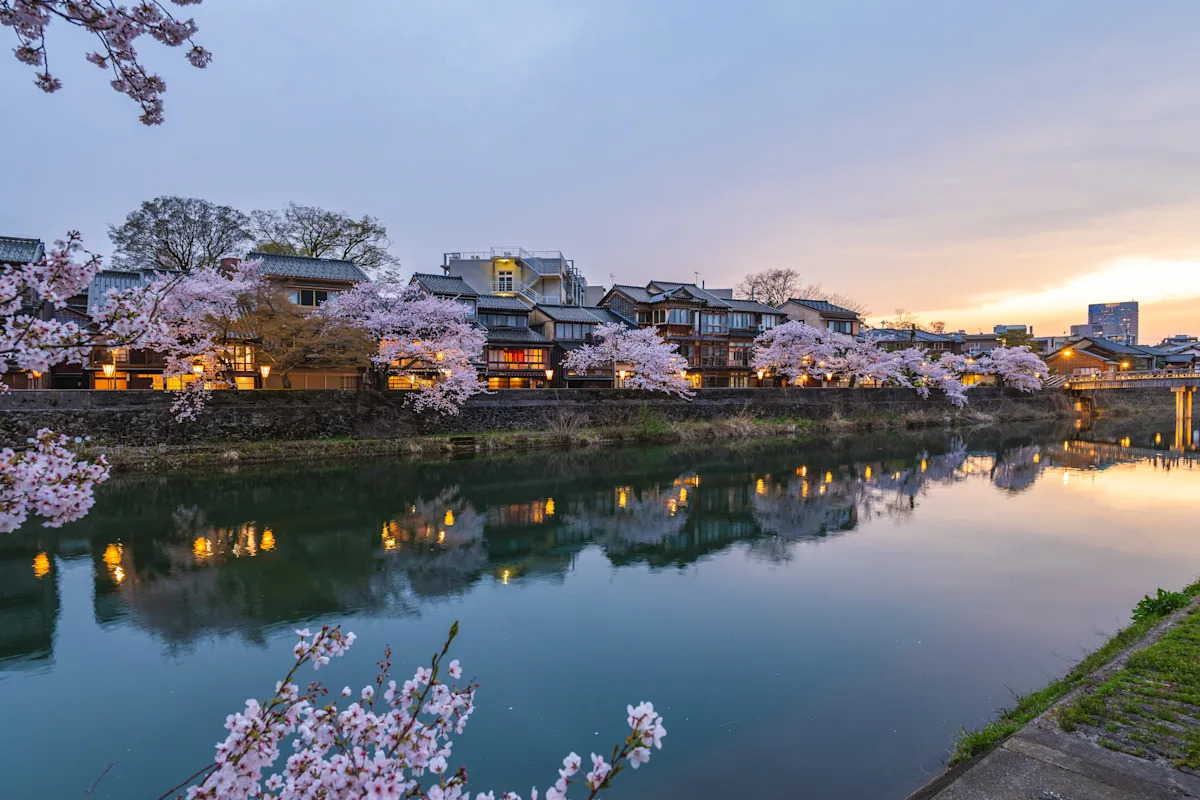
Higashi Chaya District on a snowy day in Kanazawa, the capital city of Ishikawa Prefecture, Japan.
(Sanghwan Kim via Getty Images)
Kanazawa: Japan’s “Little Kyoto” Without the Crowds
Kanazawa is located on Japan’s western Sea of Japan coastline, about two and a half hours from Tokyo by bullet train on the Hokuriku Shinkansen. Accommodations here run about 30 to 40 percent below comparable Kyoto prices, and the major sites are genuinely walkable and manageable without the crowd pressure. That alone had me sold.
What makes Kanazawa so special is how it survived history. While Tokyo, Osaka, and Kyoto all sustained damage during World War II, Kanazawa’s lack of military-industrial infrastructure spared the city, preserving intact streetscapes of wooden townhouses, samurai residences, and geisha districts that disappeared elsewhere. Walking through this city is like stepping into an untouched version of old Japan.
The Must-Do Kanazawa Itinerary (2 to 3 Days)
Morning: Kenroku-en Garden
Start your first morning at Kenroku-en, and try to get there when it opens. Admission is 320 yen, and entry is free during early morning hours. This is widely considered one of Japan’s three most beautiful gardens, and it transforms with every season, from cherry blossoms in April to the dramatic yukitsuri snow protection installations in winter. Kanazawa Castle Park sits right next door and is well worth adding to your morning walk.
Midday: Omicho Market
From the garden, head to Omicho Market for lunch. This market has a 300-year history and about 170 stores offering Kanazawa specialty products, including fresh seafood caught nearby, local traditional vegetables, and spots where you can eat on the spot, like seafood rice bowls, Kanazawa curry, and grilled Noto beef skewers. Kanazawa’s coastal location gives it access to some of Japan’s freshest fish, caught in the cold waters of the Sea of Japan, and you can watch the fishmongers work up close.
Afternoon: Higashi Chaya District and Nagamachi Samurai District
These two historic neighborhoods are the heart of Kanazawa’s old-world magic. The Higashi Chaya District is where geisha once entertained guests, with teahouses that are open to the public. The Shima Teahouse has been preserved as a museum displaying the rooms geisha used, with traditional Japanese instruments still on display. The Nagamachi Samurai District sits nearby, with its stone-paved paths and earthen walls that have stood for centuries. You can actually tour the interior of the samurai residences here, which is a completely surreal experience.
Day Two: The Art and Craft Side of Kanazawa
Kanazawa produces 99 percent of Japan’s gold leaf, and you’ll find gold leaf workshops available throughout the city. This is one of those experiences that’s genuinely worth doing and not just for the ‘gram. The 21st Century Museum of Contemporary Art is also a must. Inside the circular structure is Leandro Erlich’s famous “Swimming Pool,” where visitors can enter from the bottom and experience the illusion of standing underwater. It is as wild and wonderful as it sounds.
Kanazawa is also the confectionary capital of Japan, home to over 150 bakeries. Set aside time to wander and snack.
Getting There: The Hokuriku Shinkansen from Tokyo runs about 2.5 hours, and the Hokuriku Arch Pass at around 24,500 yen for 7 days covers Tokyo, Kanazawa, Kyoto, and Osaka, making it a smart option if you’re building a broader itinerary.
Fukuoka: The City That Will Surprise You the Most
If Kanazawa is the culture-lover’s alternative to Kyoto, Fukuoka is the city for everyone who wants a more vibrant, food-forward, modern Japan experience without the overwhelm of Tokyo. Fukuoka consistently ranks as one of the most livable cities in Asia and one of the easiest entry points into Japan, with a compact layout, excellent public transport, and more character per square kilometer than almost anywhere else in the country.
The city’s location is a big part of what shapes its personality. Because of its closeness to the Asian mainland, Fukuoka has been an important harbor city for centuries, and today it carries that global influence in its food scene, its energy, and its openness to visitors. It feels cosmopolitan in a way that is distinctly its own.

Fukuoka, Japan – April 7, 2024: Nakasu area with city skyline reflection along riverbank. Here is entertainment district, filled with restaurants and stores.
(blanscape via Getty Images)
The Must-Do Fukuoka Itinerary (2 to 3 Days)
Day One: Hakata, Ohori Park, and the Castle Ruins
Start your first morning in the historic Hakata district, the oldest part of the city. Kushida Shrine is free and open year-round, and the Hakata Machiya Folk Museum costs just 200 yen for a really authentic look at the city’s merchant history. From there, make your way to Ohori Park, a sprawling lakeside green space that feels like a quiet retreat in the middle of everything. Wide walking paths circle the water, small bridges connect garden sections, and the open views across the lake create a calming contrast to the nearby streets. Come close to sunset if you can, when the light across the water turns completely golden.
Fukuoka Castle Ruins are right next door, and they are the best cherry blossom spot in the city if you happen to be visiting in late March or early April.
Evening: The Yatai Stalls on Nakasu
This is the experience that will make you fall in love with Fukuoka. The yatai are small open-air food stalls that appear at sunset, offering an intimate dining experience where you sit close to the chef and other customers. The Nakasu island area features the most iconic row of stalls along the riverbank. They look improvised from the outside, with a propane burner, six stools, and a canvas roof, but they’re licensed and inspected. Eat at them without hesitation. Order the tonkotsu ramen. Fukuoka is considered the Noodle Capital of Japan for its tonkotsu ramen with ultra-fine noodles, dished out every day in big bowls at more than 100 stalls across the city.
Day Two: Dazaifu Day Trip and Canal City
Dazaifu is about 30 minutes away and costs 410 yen each way. The highlight is Tenmangu Shrine, where you can pick up Umegae-mochi, a grilled rice cake filled with sweet plum bean paste, from the charming shops lining the approach. The Kyushu National Museum is also here.
Back in the city, Canal City Hakata is worth an afternoon. It is flashier and more commercial than the rest of your itinerary, but the architecture is genuinely striking and it houses the Ramen Stadium on the fifth floor, where multiple famous regional ramen shops from across Japan share one space. A solid lunch stop before or after the shrine.
Getting There: Fukuoka Airport sits five minutes from Hakata Station by subway, making it Japan’s most convenient major gateway. No long express trains, no highway buses. The Shinkansen from Tokyo to Fukuoka’s Hakata Station takes around five hours on the Nozomi. If you’re routing through Osaka or Kyoto first, Fukuoka makes a perfect final city on your loop.
How to Plan Both Cities Into One Trip
The beauty of Kanazawa and Fukuoka is that they pair perfectly on a broader Japan itinerary without feeling repetitive. A classic routing that works really well:
Tokyo (3 nights) → Kanazawa (2 to 3 nights) → Kyoto (2 nights) → Fukuoka (2 to 3 nights)
Kanazawa functions perfectly as a two-to-three day stopover between Tokyo and Kyoto via Hokuriku Shinkansen, providing contrast to Kyoto’s intensity while delivering comparable aesthetic and historical satisfaction. Then you can catch the Shinkansen from Kyoto through Osaka down to Hakata Station in Fukuoka for a lively, food-focused close to your trip.
A good tip on the Japan Rail Pass: run the numbers for your specific route before buying. For long loops covering Fukuoka and Kanazawa, the pass can still make financial sense, especially if you are making four or more shinkansen legs in a week. Use a site like Navitime to price each leg individually before committing.
The Basis of Your Trip
Japan’s alt-cities are not lesser versions of Kyoto and Tokyo. They are entirely their own experiences, and in many ways they offer something the big headliners can not quite deliver anymore: the feeling that you are actually in Japan, not just at Japan. The gold leaf workshops and geisha quarters of Kanazawa, the yatai ramen and riverside energy of Fukuoka, the manageable crowds and the local interactions, it all adds up to a trip that genuinely stays with you.
Plan smart, go slower, and go beyond the obvious. Your most unforgettable Japan memories might be waiting in a city you almost skipped.
