
Why Ukraine Is Mining Russian Supply Routes With Drones
Ukraine’s campaign against Russian logistics is becoming more sophisticated. In addition to striking trucks, fuel depots and supply convoys, Ukrainian drones are reportedly dropping mines along key supply routes, forcing Russian forces to contend with threats from both the air and the road below.
Russian sources have reported drone mine-laying along sections of the land corridor to Crimea, particularly around the Mariupol–Melitopol highway. After renewed Hornet drone attacks and suspected scatter-mining along the M-14 route from Mariupol toward Chongar, authorities closed part of the highway and rerouted heavy truck traffic heading toward Crimea.
Rather than simply destroying individual vehicles, the aim is increasingly to disrupt the flow of supplies moving to the front. Ukrainian Minister of Defense Mykhailo Fedorov has described the effort as a “logistical lockdown” of the Russian army, saying Ukraine is scaling up “middle strike” attacks on the enemy rear.
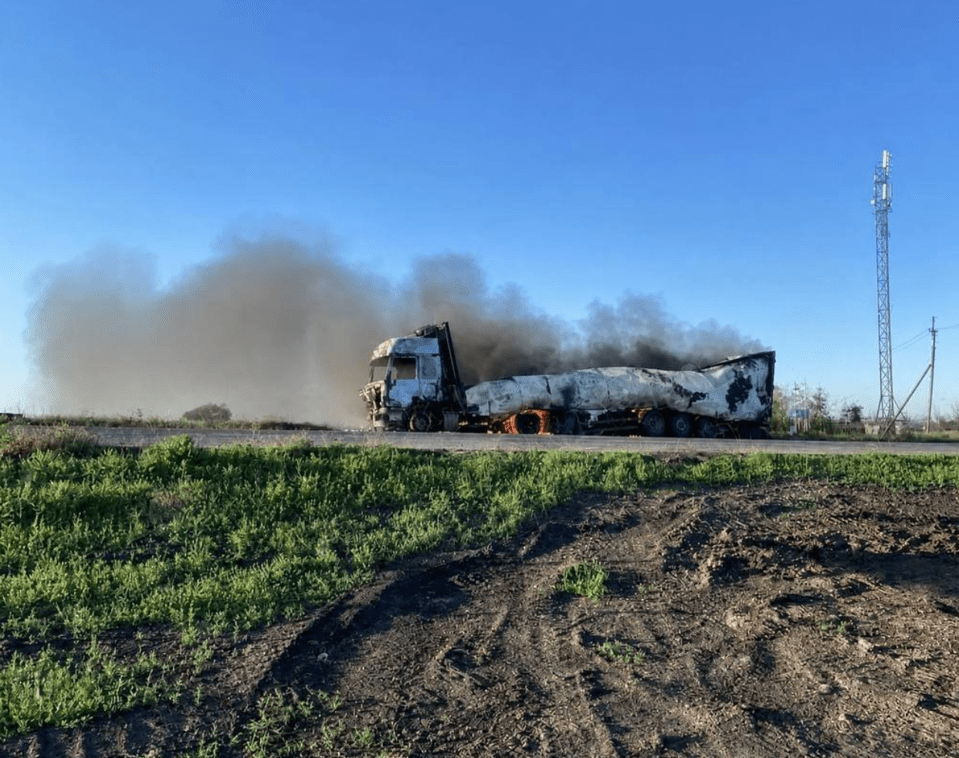
There are signs this is already being applied beyond the M-14. On May 29, Volodymyr Saldo, the Russian-installed governor of occupied Kherson region, said a drone had dropped mines onto the roadway and shoulder of the R-280 “Novorossiya” route near the Kherson-Zaporizhzhia border.
A Kamaz truck was reportedly destroyed, several vehicles were damaged and part of the road was closed. The incident came days after Saldo temporarily restricted freight traffic along the same route following Ukrainian strikes on fuel tankers and trucks moving toward Crimea.
The reported mining is notable because the M-14 between Mariupol and Melitopol lies roughly 100-150 kilometers from the front, meaning Ukraine would likely need fixed-wing drones or other longer-range systems to seed mines there.
According to Roy Gardiner, an open-source analyst, the 3D-printed devices use motion-sensitive or possibly magnetic-influence fuses and contain enough explosive to immobilize vehicles.
The mines do not necessarily need to destroy vehicles outright. A disabled truck can block a road, create congestion and leave stranded vehicles vulnerable to drone strikes. “This will further increase the pressure on Russian logistics and add the burden of having to constantly clear these mines,” Gardiner told me.
The tactic appears to be part of a broader Ukrainian effort to turn Russian supply routes into layered interdiction zones. Drivers already contend with FPV ambush drones, AI-enabled strike drones and attacks on the air defenses protecting key roads. If drone mine-laying expands, they will also face the constant risk of mines on the road below.
One sign of the pressure came when Ukraine’s Special Operations Forces reported striking two Russian Tor-M2 air defense systems. One was hit while being transported by tractor along the M-14 highway near occupied Berdiansk, suggesting Russia is moving air defenses to protect vulnerable logistics routes.
Russian military bloggers have warned that even small mines scattered along key highways could repeatedly halt traffic for inspections and demining operations.
The Russian war blogger Military Informant warned that “even small mines regularly scattered along roads could lead to transport paralysis,” as traffic would have to be repeatedly halted for inspections and demining operations. Unlike kamikaze drone strikes, which target individual vehicles, mine-laying can affect every vehicle using a route. A batch of mines can temporarily shut down a highway.
For an army dependent on long and vulnerable supply lines, slowing movement can be as valuable as destroying vehicles. “Logistics have been disrupted for almost a month, affecting the delivery of supplies not only to the rear but also to the front lines,” wrote the Russian warblogger Archangel of Special Forces.
Dropping mines with drones is not a new tactic. Both Russia and Ukraine have used drones to remotely seed minefields for years. During a reporting trip in 2024 with Ukraine’s 23rd Mechanized Brigade near Chasiv Yar, I observed operators using Vampire bomber drones to drop anti-tank mines on Russian supply routes.
Oleksandr Shatrovsky, a drone operator with Ukraine’s 60th Mechanized Brigade, told me the technology already exists to make such operations more scalable.
“There are solutions that allow multiple fiber-optic ‘waiting drones’ – ambush FPVs – to be operated simultaneously from a single control station,” Shatrovsky said. “The same applies to mining operations using bomber-type fixed-wing drones. I think these are quite effective solutions and definitely have their place.”
Russia may eventually adapt. Gardiner noted that Russian forces could respond by extending overhead netting onto vulnerable highways, similar to the anti-drone tunnels already appearing on roads closer to the front. Extending such protection across hundreds of kilometers of highway would be a far more demanding task.
That matters around Crimea, where open-source military analyst Jakub Janovsky told me Ukraine has concentrated significant resources on striking air defenses and long-range fire assets. Once those systems are suppressed, higher-value targets they were guarding, including airbases and missile launchers, become more vulnerable.
The drone strikes and mine-laying campaign could further increase Russia’s reliance on the Kerch Bridge, one of the few remaining major supply arteries linking Crimea to Russia.
Ukraine does not need to cut the land corridor to Crimea entirely. If every truck takes longer, every convoy requires clearance, and every delay exposes more targets, the road can remain open while becoming far less useful.
This article was originally published on Forbes.com
