
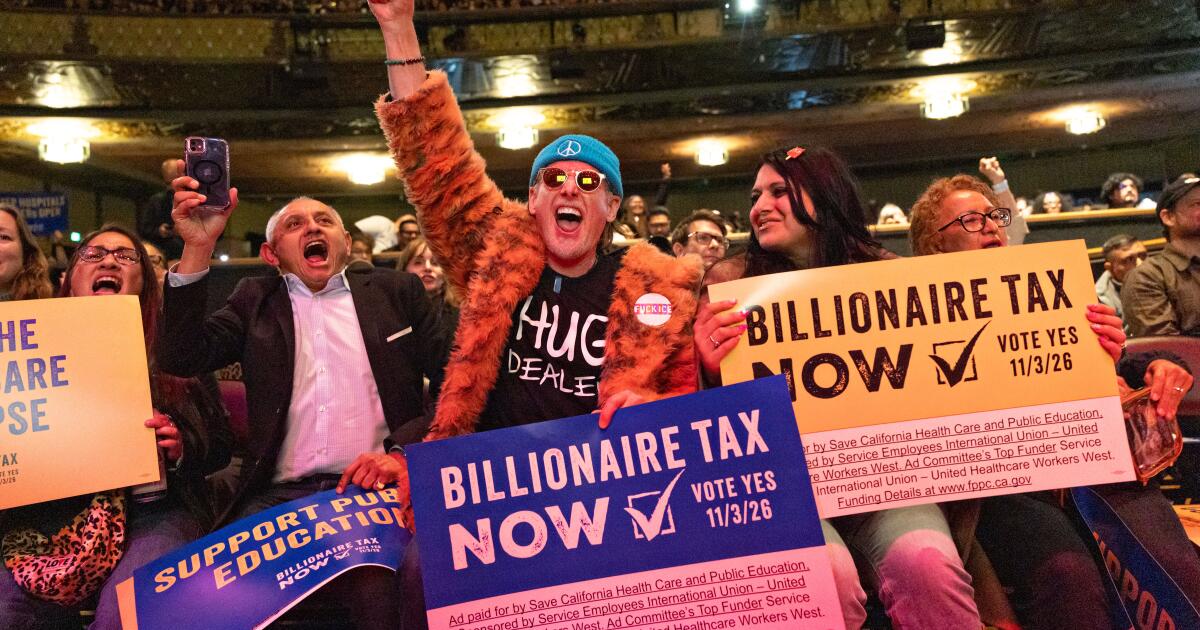
California billionaire tax proposal attracts 1.5 million signatures. Here’s what happens next
California, home to the ultra-rich in Silicon Valley and Hollywood, is embroiled in a heated fight over whether to tax billionaires to fund healthcare.
This week, supporters of the proposed billionaire tax began submitting nearly 1.6 million signatures, nearly twice the number needed to qualify for the November ballot.
Election officials now need to verify that the signatures are valid for the initiative to land on the ballot.
The proposal would impose a one-time tax of up to 5% on taxpayers and trusts with assets valued at more than $1 billion, with some exclusions, such as property.
Supporters of the tax, including the Service Employees International Union-United Healthcare Workers West, say it would raise $100 billion, offsetting federal funding cuts to healthcare. A small portion of the funds would also go toward education and state food assistance.
If the proposal makes it to the ballot, it sets the stage for an intense, costly battle over whether the state’s billionaires should pay for services that lower-income residents depend on. Some tech moguls have pushed back against the idea and threatened to move. Some have already moved.
Voters will probably be bombarded with political ads and arguments from opposing sides as the battle intensifies.
Here’s what could happen next:
What are supporters arguing?
Supporters of the billionaire tax are tapping into people’s frustrations about healthcare and wealth inequality. They’ve pushed back against the idea that billionaires can avoid the tax by moving, noting that it applies to billionaires residing in California as of Jan. 1, 2026.
“When funding is cut, it brings a world of pain,” said Mayra Castañeda, an ultrasound technologist and a member of SEIU-United Healthcare Workers West, in a statement. “It means longer ER waits, fewer healthcare workers, rural hospitals shutting down, delayed care and lives lost that could have been saved.”
Vermont Sen. Bernie Sanders has backed the idea.
“At a time of massive income and wealth inequality, the richest people in our country must start paying their fair share of taxes,” he posted on social media site X on Monday.
What are opponents arguing?
Opponents say the tax could harm California’s economy and leadership in innovation without addressing the state’s financial woes.
“Because the state relies so heavily on high-income-earner tax revenue, this measure could lead to reduced budget revenue in the long term as highly mobile wealthy individuals leave the state to avoid this new tax,” said Rob Lapsley, president of the bipartisan California Business Roundtable.
The Legislative Analyst’s Office said last year that it is hard to predict the exact amount the state will collect because of factors such as fluctuating stock prices, which affect wealth. In a December letter, the office said the state would probably collect tens of billions of dollars from the wealth tax, but it could also lose other tax revenue.
California Gov. Gavin Newsom opposes the wealth tax proposal. Earlier this year, he told Bloomberg he had concerns about how the proposal had been drafted. He also expressed fears that wealthy taxpayers will move out of the state.
“The impact of a one-time tax does not solve an ongoing structural challenge,” he told the news outlet.
How much are opponents spending to fight the billionaire tax proposal?
Billionaires are spending millions of dollars to fund groups that are fighting the proposal or promoting other solutions they say would address wealth inequality.
In late December, PayPal and Palantir co-founder Peter Thiel contributed $3 million to the California Business Roundtable, which is opposing the billionaire tax, according to spending data filed with the secretary of state.
In March, former Google Chief Executive Eric Schmidt donated $1 million to that group. Other tech executives have contributed hundreds of thousands of dollars this year. It’s unclear how much of that money goes toward opposing the tax since the donation was made to the entire group.
Since January, tech executives, venture capitalists and business leaders have donated roughly $93 million to a nonprofit called Building a Better California, according to data on the secretary of state’s website. A large chunk of that funding came from Google co-founder Sergey Brin, who donated $57 million to the nonprofit. Executives from DoorDash, Ripple, Stripe and other companies have also contributed to the group.
Building a Better California’s website outlines policies it supports, such as expanding affordable housing and more transparency in state government. The group has told donors that it offers “near-term and longer-term protection against wasteful government spending and any and all new taxes on personal property and personal assets.”
Brin, who relocated to Nevada last year, told the New York Times that he fled “socialism” when his family left the Soviet Union in 1979, and he doesn’t “want California to end up in the same place.”
Are there other proposals that could kill the billionaire tax?
Yes. Another initiative, known as the “Improving Transparency, Effectiveness & Efficiency in California Government Act,” could nullify the billionaire tax act.
It would prevent new taxes from being exempt from a voter-approved state spending limit, in contrast to the billionaire tax measure.
Supporters of the transparency act, including Building a Better California and Inland Empire Economic Partnership, plan to submit about 1.5 million signatures to county election officials this week.
If voters approve conflicting ballot measures, the one with more yes votes would take effect.
How much have groups spent on a ballot measure in the past?
Hundreds of millions of dollars has been spent on ballot measures in the past. In 2020, a record $200 million was spent on Proposition 22.
The initiative, funded by Uber, Lyft, DoorDash and other businesses, allowed gig companies to classify their workers as contractors rather than employees.
With the battle over the billionaire tax expected to heat up, spending on both sides is likely to climb.
Times staff writer Seema Mehta contributed to this report.
