
How Male Cichlids Trick Females into Fertilizing Eggs
The post How Male Cichlids Trick Females into Fertilizing Eggs appeared first on A-Z Animals.
Nature always finds a way, but those ways aren’t necessarily pretty. In fact, in regions with plenty of resource competition, deception is a surefire way to ensure that your genetics get passed on to the next generation. Take it from male haplochromine cichlids, a large tribe of cichlid fishes best known from Africa’s Great Lakes and other waters across parts of Africa and the Middle East. In many modern haplochromine species, males develop yellow, orange, or reddish “egg spots” on their anal fins that resemble eggs. To make matters stranger, the females often engage in mouthbrooding (holding eggs in their mouths).
In a typical spawning sequence, the female lays eggs and quickly takes them into her mouth. Males then present the egg spots on their anal fins, and females may nuzzle or mouth those markings as the male simultaneously releases sperm, thus fertilizing the eggs in her mouth. It’s an underhanded business, to be sure. However, research suggests egg spots may play a more complicated role than simple mate attraction, with evidence pointing to both spawning behavior and male-male signaling. Let’s learn more about this strange, slightly disturbing, and evolutionarily advantageous method that male haplochromine cichlids use to pass on their genes.
Meet the Haplochromine Cichlids
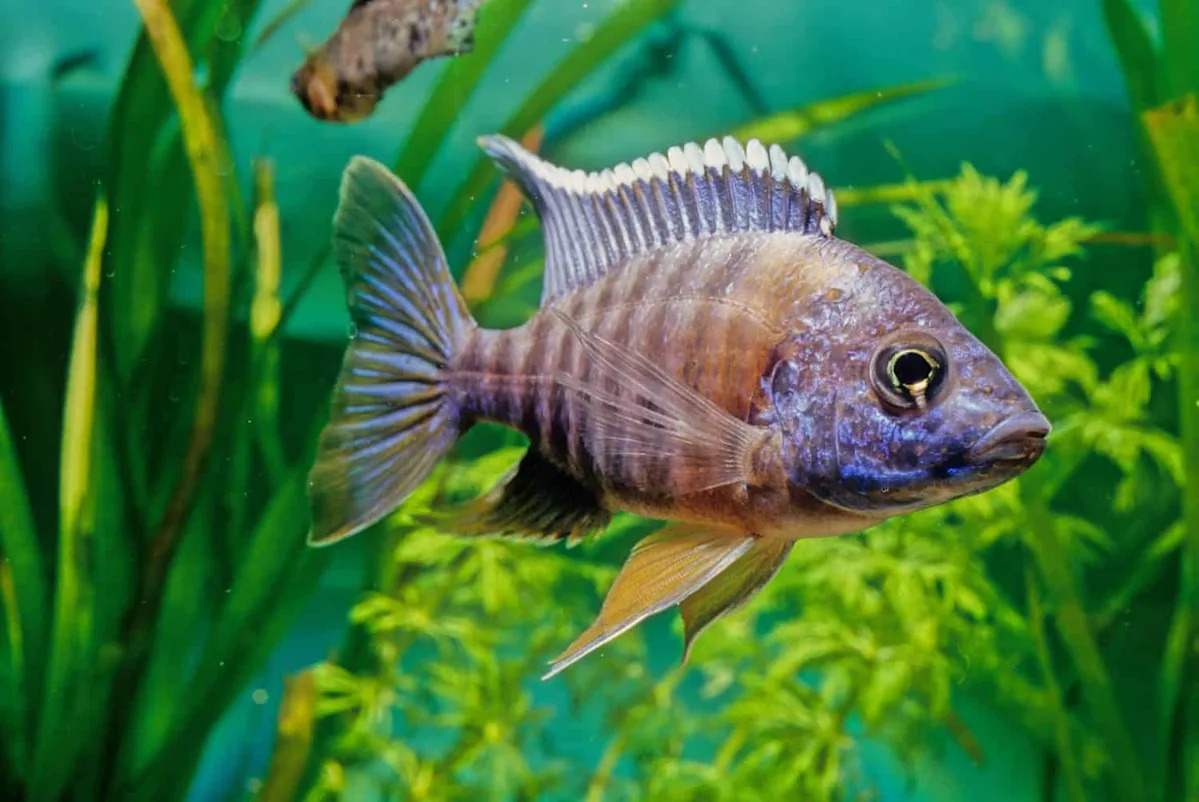
Thanks to adaptive radiation, cichlid fish feature a variety of colors, features, and behaviors.
©hodim/Shutterstock.com
Haplochromine cichlids are a tribe of cichlid fishes that includes hundreds of species, with some estimates placing egg-spot-bearing haplochromines at roughly 1,500 species. This tribe lives across eastern, southern, and northern Africa, as well as the Middle East. However, they dominate the African Great Lakes. Their presence in large bodies of water like Lake Malawi and Lake Victoria has led to one of the more remarkable examples of adaptive radiation on Earth. Cichlids in the African Great Lakes exhibit an extraordinary range of behaviors, including territoriality, specialized feeding strategies, complex courtship displays, and mouthbrooding. The latter involves incubating eggs or young in the mouth of a parent for extended periods. Several types of creatures perform this behavior, including cichlids and Darwin’s frogs, in which the male broods young in its mouth or vocal sac.
Smoke and Mirrors
Mouthbrooding has resulted in one of the more deceptive approaches to reproduction in the animal kingdom. Male haplochromine cichlids grow spots on their anal fins that look similar to female eggs. Because females take eggs into their mouths during spawning, the egg-like markings may stimulate females to mouth or nuzzle at the male’s anal fin. As they do, males surreptitiously fertilize the eggs in the mouths of females that get close enough, thus ensuring their genes get passed on. This may seem unusual, but egg spots are widespread among modern haplochromine cichlids and have long been linked to their courtship and spawning behavior. Research on female preference is mixed. Earlier studies in some species suggested females preferred males with egg spots, while a 2012 study in Astatotilapia burtoni found no preference for males with more egg spots and even a tendency for females to prefer males without them.
In Astatotilapia burtoni, later work found no clear female preference for males with more egg spots and reported a tendency for females to prefer males without them. However, the latest research in this area changes that picture. It shows how integral, yet plastic, this reproductive practice is for mouthbrooding cichlid species. Scientists recently discovered the cellular makeup of these anal-fin egg spots. They also discovered that the gene responsible for producing these egg spots appears to be suppressed when males are kept in social isolation.
Colorways
A 2024 study in Evolution & Development examined how egg spots form at the cellular level and how their development can shift with social environment. The study found that egg-spot formation in Astatotilapia calliptera involves iridophores and xanthophores, with iridophores playing a key role in initiating the pigment-cell aggregations.
Earlier genetic research identified fhl2b as a strong candidate gene involved in the formation of haplochromine egg spots. These markings form through coordinated pigment-cell development, including iridophores and xanthophores, and previous work has linked the gene fhl2b to egg-spot morphogenesis. Given their true-to-life appearance, it is no wonder these egg spots trick female cichlids into approaching.
It Takes a Village

Social isolation can affect the timing of egg-spot development.
©Alisha Falcone/Shutterstock.com
That same study found that social environment influenced the timing of egg-spot formation, with iridophores appearing to be the pigment cell type most responsive to that change. In the study, individuals isolated earlier began forming egg-spot aggregations sooner. Rather than showing that isolated males lost egg spots, the research suggests that egg-spot development is developmentally flexible and can shift depending on social conditions.
In a way, this helps reconcile the contradictory research on the importance of egg spots in reproduction. Males use their egg spots to lure females close enough for fertilization. However, females did not necessarily reproduce with egg-spotted males more than with those without. This suggests that the egg spots are more akin to peacocking than any surefire reproductive approach. In fact, they may also function as visual signals in male-male communication.
Much like the size of a red deer’s antlers or the facial spot complexity of a paper wasp, egg spots are a biological gauge of a male cichlid’s social standing and reproductive health.
The post How Male Cichlids Trick Females into Fertilizing Eggs appeared first on A-Z Animals.
