SCOTUS’s Anti-Constitutional Crusade to Create Second-Class Citizens
Another Supreme Court term has come and gone, and civil society is once again licking its wounds. President Donald Trump has obtained new power, the lives of trans people have gotten worse, and the high court is basically winging it when it comes to its ill-fated new “history and tradition” test on guns. At the same time, things could have gone worse—at least for all of you who work at the Federal Reserve.
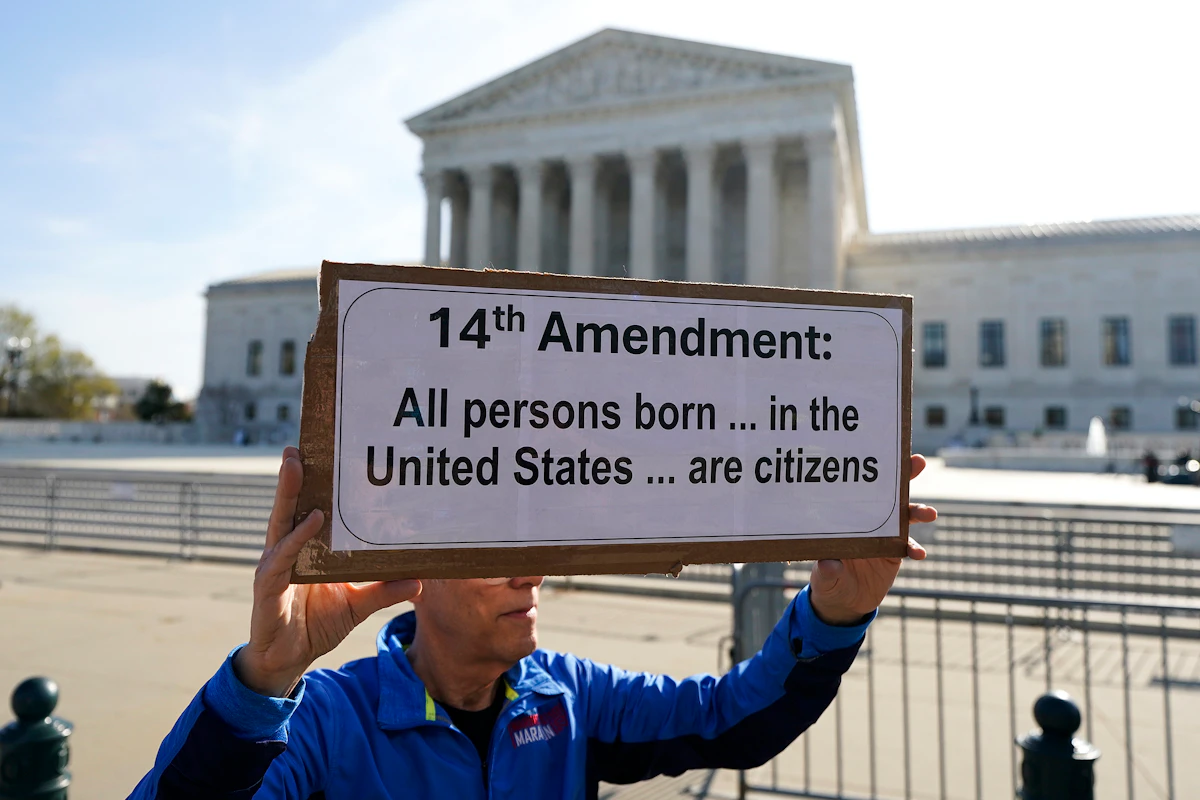
The biggest bullet dodged was this week’s decision in Trump v. Barbara, in which the court ruled against Trump’s executive order attempting to nullify the birthright citizenship rights explicitly granted by the Constitution. One of the grand plans of this administration has been to ethnically cleanse the United States, and had the court gone along with Trump and his aide-de-camp, Stephen Miller, millions of Americans might now be facing the end of their citizenship—including the U.S. World Cup team’s current leading scorer, Folarin Balogun. Despite this rare victory of reason over right-wing nuttery, I think we should be concerned that the conservative legal movement still has its eye on waging war on the so-called Reconstruction Amendments—especially the one that grants birthright citizenship in the first place: the Fourteenth Amendment.
I raised an alarm last year about the far right’s desire to delete the Fourteenth. The amendment is a substantial target for the MAGA movement because of the unique way it enables and extols the promise of a multiracial democracy, something that Trump and his minions have sworn to destroy. And the way the Supreme Court overrode the disqualification clause, granting Trump the right to run for office again without any concern for the Constitution’s explicit admonitions against insurrectionists holding high office, gave abundant hope to those who’d like to see the Fourteenth Amendment dismantled.
Do the court’s conservatives disdain the Reconstruction Amendments? “They definitely do, to a certain extent,” says TNR’s Matt Ford. “They’ve largely read the Fifteenth Amendment out of the Constitution, in Brnovich and Callais, by making it impossible to properly enforce the Voting Rights Act, and they more or less nullified the disqualification clause in Trump v. Anderson. There are parts they’re fine with, like the equal protection clause in some circumstances, but they’ll never interpret it as broadly as the liberals.”
Ford says that the most charitable read is along the lines of what Justice Clarence Thomas said in his dissent in Trump v. Barbara. “They generally think the Reconstruction Amendments were designed to address the specific circumstances and exigencies of the post–Civil War era,” he says, “and that while they can have plenty of applications beyond that, they aren’t meant to be used to (in their view) fundamentally restructure American society anymore or provide special treatment for anyone.”
Here’s where the biggest conflict lies, as the liberal position is generally that the Reconstruction Amendments were a second founding, not a postbellum clean-up. “In this view,” says Ford, “Congress has broad powers to ensure that there is no American underclass or subaltern population, which Jim Crow nonetheless managed to create for about 90 years.”
Justice Ketanji Brown Jackson got at this in her concurring opinion, in which she took issue with Thomas’s dissent on these lines. Thomas’s “narrow vision of the Fourteenth Amendment bears little relationship to the history of its ratification,” she wrote, adding that his take on the matter “elides the entire point of the Second Founding: The Reconstruction Amendments were an anticaste, antisubordination reset for the Nation, not a mere spot treatment for the dark stain of slavery.”
Thomas didn’t win the argument this week. But the fact that these matters are being argued in the first place is cause for serious alarm, according to former Massachusetts Senate candidate Alex Rikleen. “By even considering the legitimacy of birthright citizenship, the Roberts Court, stacked with jurists ready and willing to make anti-constitutional rulings time and again, has helped transform a fringe white supremacist attack on the 14th Amendment into a question that millions of people now understand as up for debate.”
This is hardly a new or novel fear. The Supreme Court’s ruling in Trump v. Anderson—in which they essentially deleted the disqualification clause from the Constitution—was enabled by the fact that too many were willing to countenance the idea that the plain English language of the Fourteenth Amendment was, in fact, open to interpretation. I am still angry that The New York Times in 2023 referred to the disqualification clause as “an obscure clause of a constitutional amendment enacted after the Civil War,” thus injecting a derogatory bit of editorializing into what purported to be a straight news piece.
In light of the tête-à-tête between Thomas and Jackson, I’m disturbed anew by the way the Times casually denigrated the amendments “enacted after the Civil War,” as if they were some stitched-on appendage and not language that carries the same force and lawfulness as the founding-era amendments. If the paper of record is skeptical that the Reconstruction Amendments are legitimate (and they, like the court’s conservatives, do seem interested in creating a subaltern class beyond the Constitution’s protections, for what it’s worth), this will only further the right-wing project to tear those amendments out of the Constitution and undo the nation’s second founding. So be glad that the worst didn’t happen, but stay on guard—we are not out of danger yet.