Who Owns the Declaration of Independence?
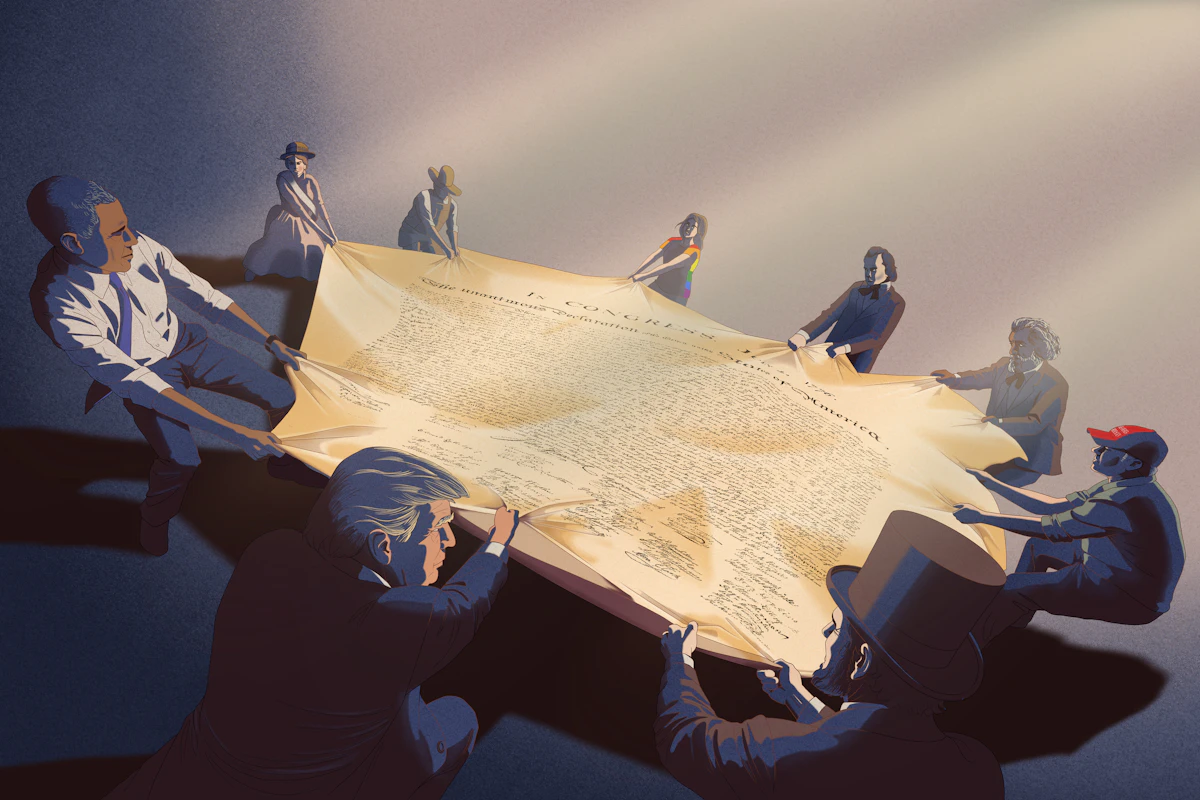
Jefferson’s character and the character of the country being written and legislated into existence would eventually be judged by the terms established in the declaration’s second paragraph. An earlier pass at the Lockean ideas it would contain had been made by fellow Virginian George Mason in his Virginia Declaration of Rights, which proclaimed, in already familiar and widely used language, “That all men are born equally free and independant, and have certain inherent natural rights, of which they cannot, by any compact, deprive or divest their posterity; among which are the enjoyment of life and liberty, with the means of acquiring and possessing property, and pursuing and obtaining happiness and safety,” and also declared that the people “hath an indubitable, unalienable and indefeasible right to reform, alter or abolish” bad governments.
On the whole, Jefferson and Congress’s reworking of those words was an improvement:
We hold these truths to be self-evident, that all men are created equal, that they are endowed by their Creator with certain unalienable Rights, that among these are Life, Liberty and the pursuit of Happiness.
That to secure these rights, Governments are instituted among Men, deriving their just powers from the consent of the governed,—
That whenever any Form of Government becomes destructive of these ends, it is the Right of the People to alter or to abolish it, and to institute new Government, laying its foundation on such principles and organizing its powers in such form, as to them shall seem most likely to effect their Safety and Happiness.
The nuances and differences in language here—between Locke’s “life, liberties, and estates,” Mason’s lengthier construction, and the declaration’s “life, liberty, and the pursuit of happiness,” for instance—have been a gift and subsidy to historians and political philosophers ever since. But whether one takes the “pursuit of happiness” to mean the pursuit of material prosperity or believes, like Jefferson’s co-draftsman Adams, that pursuing “happiness” is a matter of pursuing virtue, the declaration’s second paragraph is, plainly, about the protection and enhancement of human agency—and, as far as at least Jefferson was concerned, not merely the agency of white men either. As Harvard’s Danielle Allen has observed, the question of whether “all men are created equal” should actually be read as an assertion of universal human equality is functionally answered by Jefferson’s deleted clause about slavery, in which he unambiguously refers to slaves—“persons” whose “rights of life & liberty” had been violated, including not only nonwhite males, but women—as “MEN.”